Dingle in June
burning books and here are some pictures that I took

In wool socks, sitting by the fire, we sought to escape the dampness of the day. I’d opted to read a book on the Civil War. I was tired and, despite the subject matter, had presumed to reach for something of formal simplicity. I was wrong. The Men Will Talk to Me: Kerry Interviews by Ernie O’Malley is reworked from O’Malley’s handwritten diaries, containing records of interviews with former volunteers, almost all anti-Treaty IRA.
The text’s main body is a stream of vernacular accounts interrupted by parentheses, framing O’Malley’s queries; notes, and further comments are bracketed by the collection’s editors: O’Malley’s son Cormac and Tim Horgan. All of which are bookended by voluminous footnotes clarifying, contextualising and contradicting testimonies.
I’d been nursing a beer and reading about Reginald Hathaway, an English soldier who deserted to take up arms alongside the North Kerry IRA. He later joined the Free State army in the early phase of the Civil War and promptly defected to the IRA, this time with rifle in hand. Hathaway was attached to a flying column whose successes persuaded them to use Clashmealcon Caves as a hideout. Success prompted reprisal. Free State forces would execute him in January 1923. Without much more to go on, it’s tempting to read this as a tale of class solidarity.
Surviving Kerry republicans who raised arms against the Treaty were disinclined to accommodate the latterly formed Bureau of Military History. Some even refused the pensions offered by the de Valera government. The strength of feeling is easier to grasp when you consider the Free State’s conduct at Ballyseedy or Cahersiveen. Yet we have access to stories such as Hathaway’s, or at least in this form, because survivors who were unwilling to offer a record to state institutions willingly sat for Ernie O’Malley.
What can you say of this man? Dominant presentations offer a balance of opposites; the reputable iron man whose mind was apparently foreclosed to the complexities of politics, who possessed an elevated sensitivity to the world of art and literature. Some accounts suggest he was shot a combined 17 times during the War of Independence and the Civil War.
By 1930, he was lecturing on literature in New Mexico. His travels brought him through Peru, Mexico, and the East Coast, where he met Helen Hooker. Among his friends were Louis le Brocquy, Jack B. Yeats and Seán Ó Faoláin. He developed into a critic, editor and historian and drank with Beckett in Paris. His later years would see him employed as an advisor to John Ford, and Luke Gibbons is tempted to speculate as to whether Joyce had threaded allusions to On Another Man’s Wound, O’Malley’s first memoir, into Finnegan’s Wake. He was the last remaining republican released from internment in 1924, and when he died in Howth in 1957, it’s claimed 5 bullets remained lodged in him.
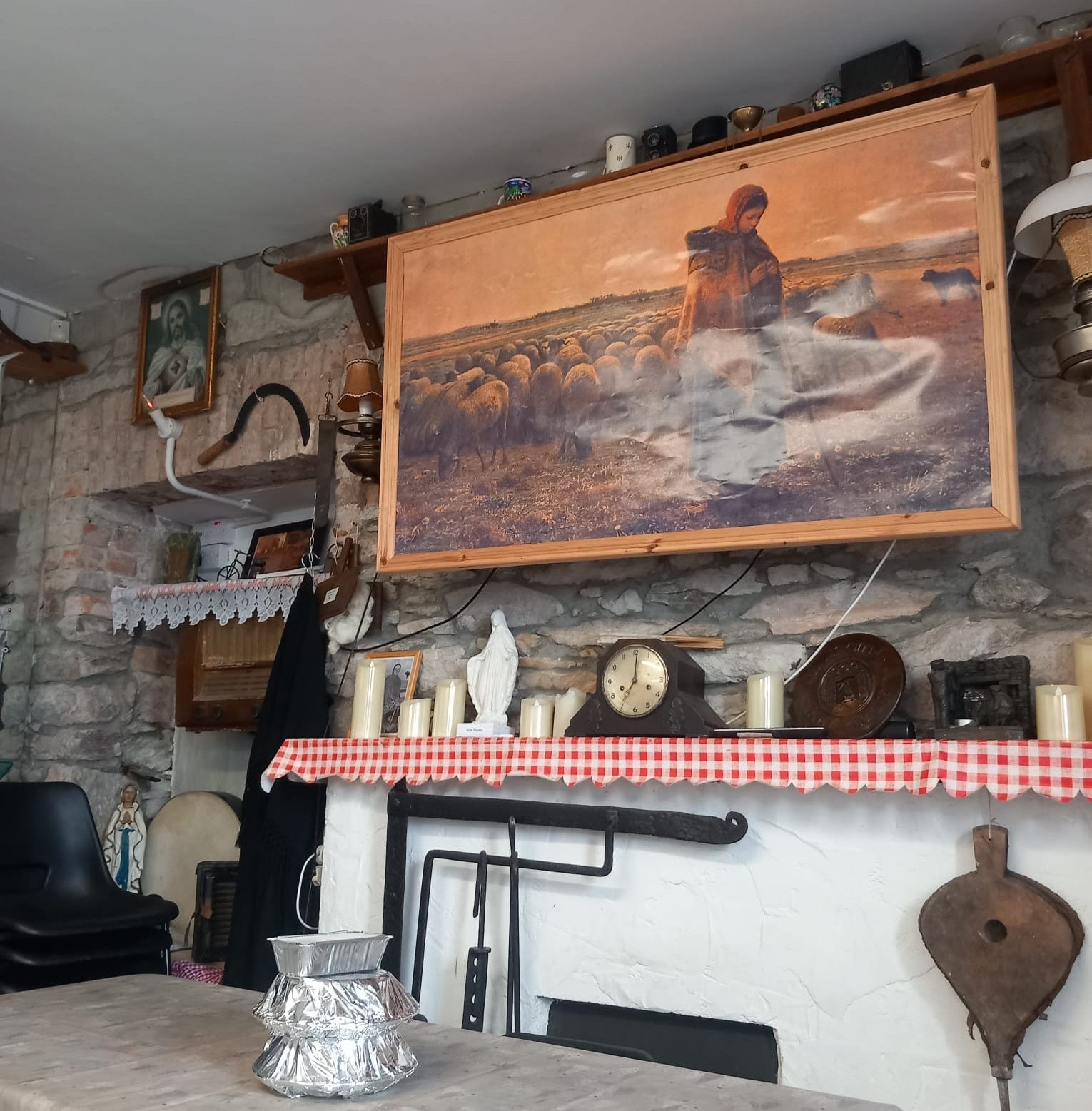
I had been unwell again through the early weeks of summer. I split time convalescing with in-laws and working remotely from a co-work setup south of Tralee. It was an old community hall, extended in various directions and functioning as a naíonra, a post-primary activity centre and a social space for retired parishioners. The baseline cost was €25 a day. For an extra €10, I could get a two-course dinner served at noon, as much tea and coffee as desired.
The woman who ran the show beamed when she told me there’d been four newborns in the parish this year alone, and she gestured to a long table where the pensioners gathered and told me I could sit anywhere I liked. An old fella pointed wordlessly to the seat next to him and I did as I was bidden. About 20 minutes into our shepherd’s pie, he gestured at me to the chap across the way: that man could play basketball. The chap gave me a nonplussed once-over: well he doesn’t play any hurling, that’s for sure.
The long dining room seemed to function as a kind of repository for the parish’s outmoded technologies: tools predating the mechanisation of agriculture, a surprising amount of antiquated cameras, many Catholic figurines and paintings awkwardly stored as if their custodian had deferred judgement on what to do with such things.
On the drive to Dingle, our daughter fell asleep. R drove up through the Conor Pass, far more familiar with the area, she suggested I climb to Peddler’s Lake. I was struck by the spectrum of colour that ran amber from the floor of the lake right up to the great amphitheatre above, the discordant layering of cliff and grass and cliff again. I crouched down to do the scene justice. But this is a problem of the right intention colliding with the wrong lens.
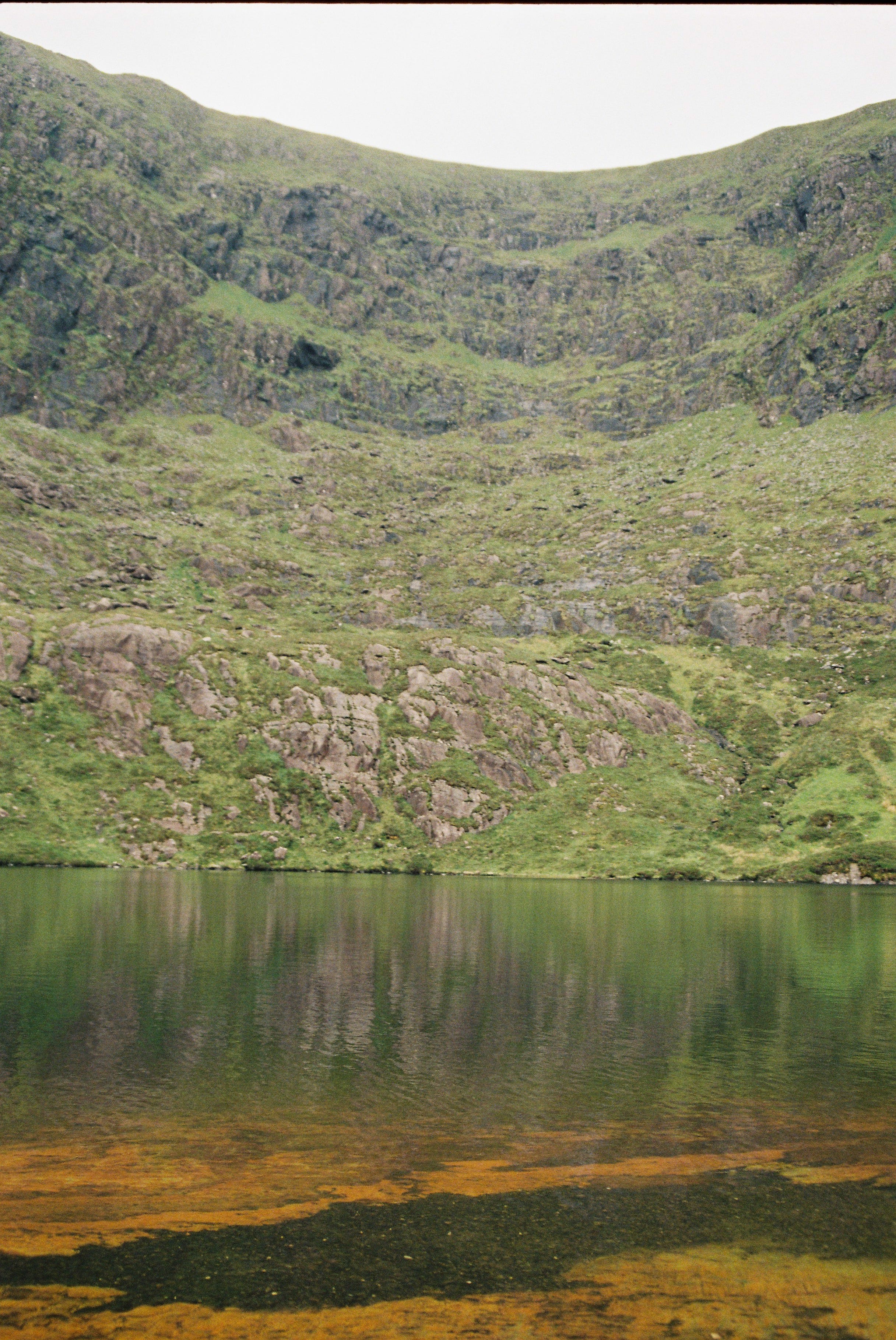
The vantage here is good. You can see the county fall out west to the coast and the peninsula stretch to the north. The pass is the only road to Dingle through the mountain. From lakeside, it’s all in clear view. A casual guess would be to say this spot was utilised during either war. A more cautious one glances over the rocky promontory of the lake and the steep drop to the pass below and gauges that a cursory eye would reconnoitre this place and sense it. Who’d be cast unsuspecting on such a stage? Back at the fire, I thumbed my copy of The Men Will Talk to Me and found Conor Pass highlighted on an incident map. The RIC attempted to cross the mountain here in the mid-summer of 1920 and the IRA ambushed them, killing two.
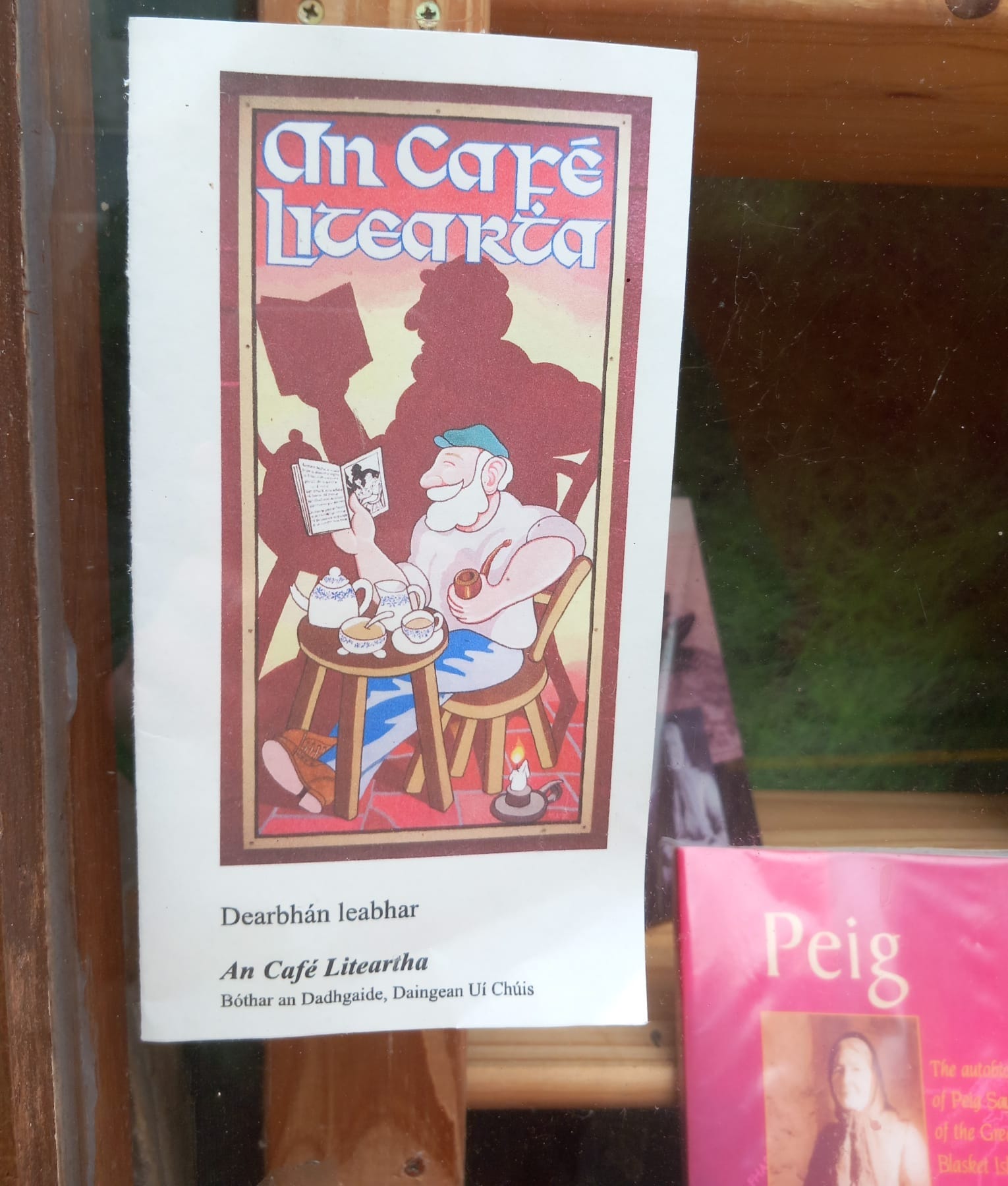
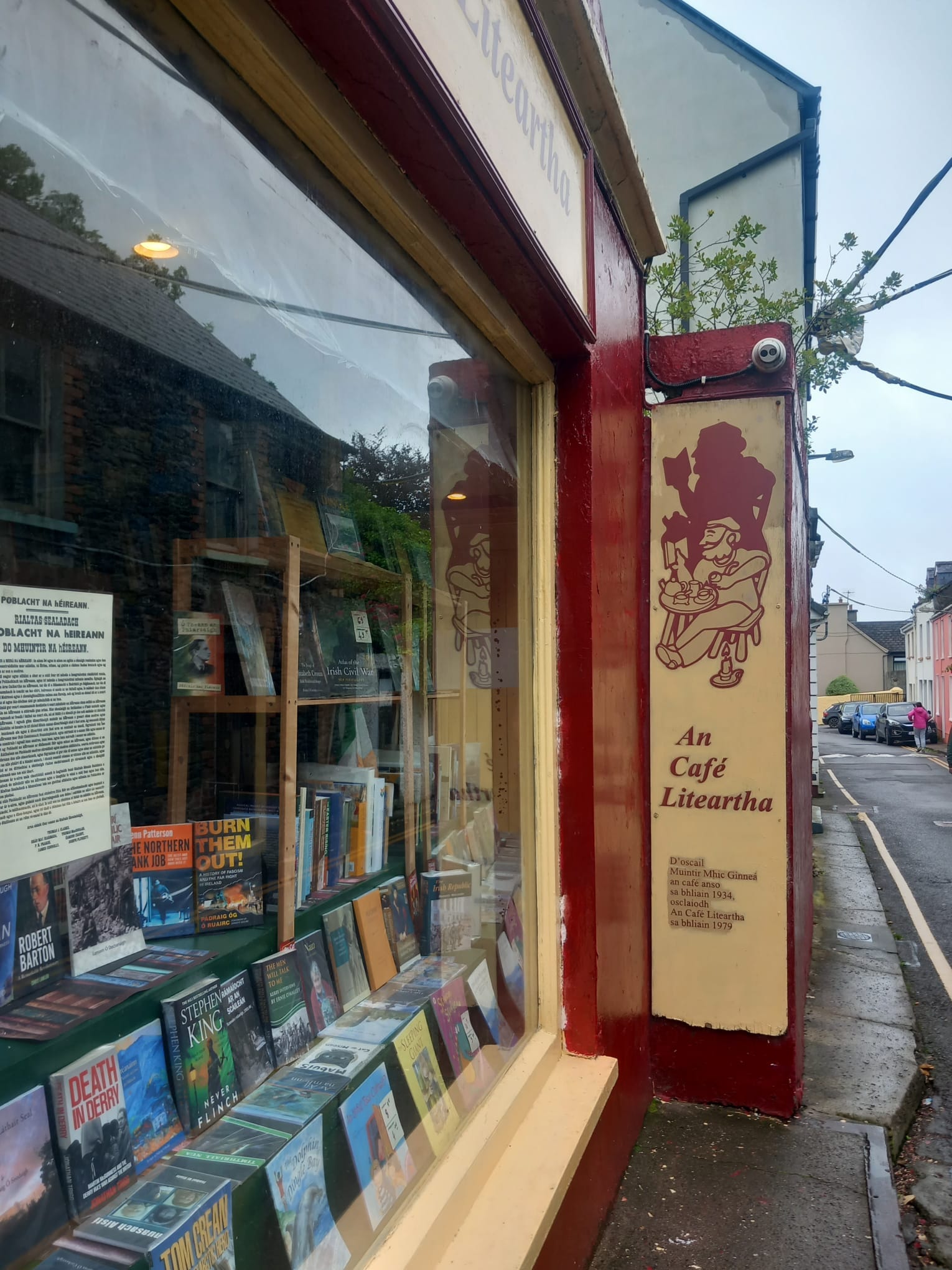
When we arrived in Dingle, it was cold and wet. We wore raincoats over wool jumpers. We visited Díseart to see Harry Clarke’s work. Our daughter had scooped up a pamphlet for a domestic violence refuge and, before I could intervene, gregariously presented it to arriving American tourists who seemed unsettled by the gift. We had coffee and cake at the back of An Café Liteartha and R chatted in Irish with the woman working there. The shop has a good selection, plenty of republican books. Most titles were on sale or discounted, despite this being the town’s high season with coachloads of tourists deposited into the side streets. I’d been reluctant to buy more books, but I put my hand in my pocket when I saw The Men Will Talk to Me going for a fraction of its usual price.
Up on the edge of the town lies the famine graveyard. When I walked up into it, my mind was blank and ill-prepared for the weight of it all. Known also as the Pauper’s Graveyard, this is the site of a roughly estimated 10,000 burials. Most graves are unmarked, and most marked are marked only with crude hefts of rock which scarcely show their necks above the grass and dandelions. An utterly affecting sight is the two cauldrons once used to serve soup to the destitute. Coarse black iron yokes that seem more suited to feeding livestock than people. I hadn’t the heart to take a picture of it at all.
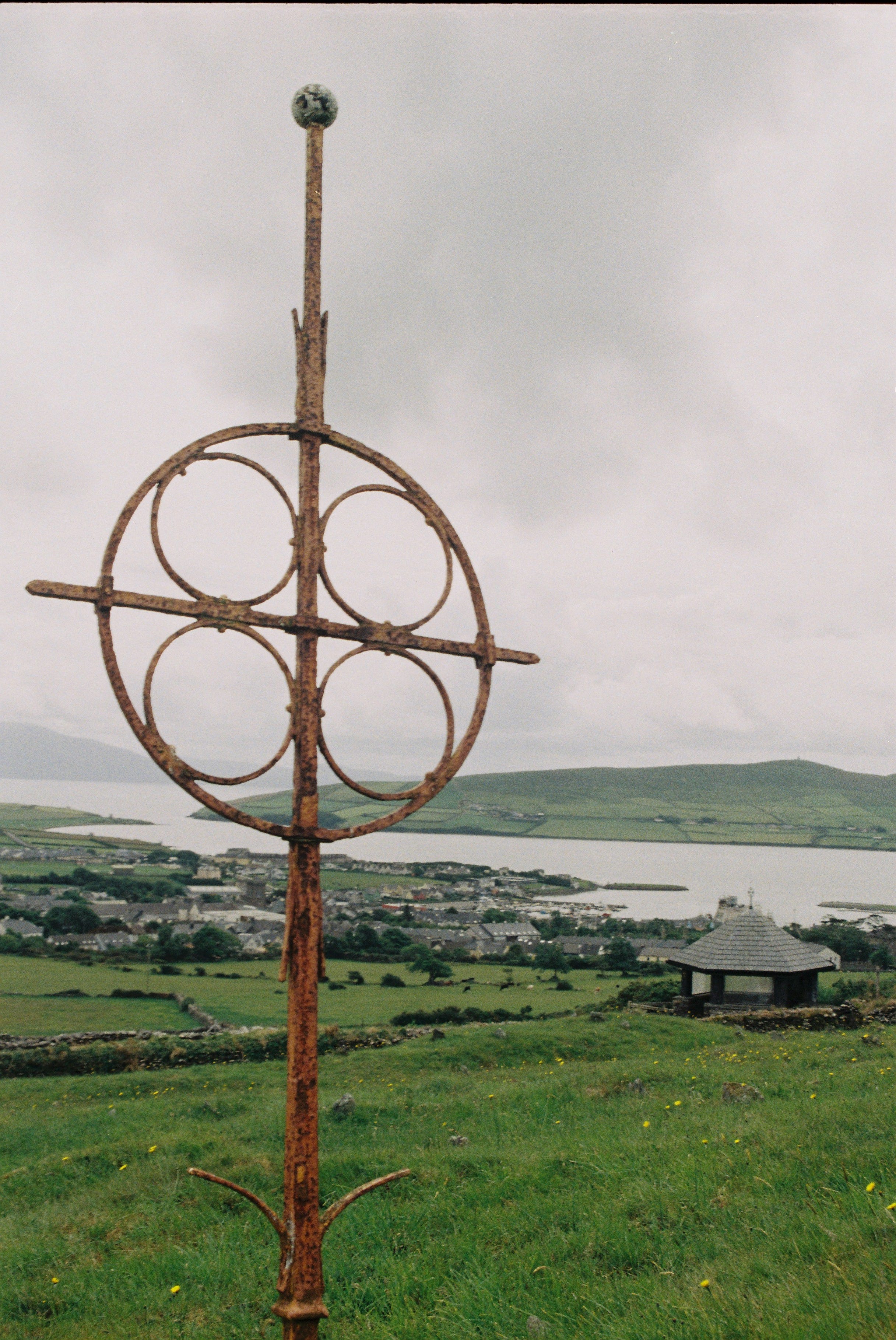
I walked back up the hill, and the sole picture I managed was this one of the cross. It feels inadequate, but I’m at a loss as to suggest technical improvements. It was a whitish overcast afternoon and a wider aperture would’ve introduced too much glare, but the colour of the rust is unfortunately muted. As far as the frame goes, I could’ve shot from a lower angle and rendered the cross with a deeper imposition, but this would’ve traded away the fjord-like appearance of the peninsula below. The result offers a sense of landscape and something of the tragedy that undergirds it. I suppose that was my intent.
The first chapter of The Men Will Talk to Me is based on an interview with Dan Flavin. Flavin was from a republican background and ran his family’s bookshop in Listowel. Being both older than the average volunteer age and an amputee, his contribution to the struggle was as a non-combatant. The British jailed him for 3 months in the spring of 1919, labelling the contents of the bookshop seditious. Later, when their soldiers turned into Listowel in 1921, they torched the shop. These details are furnished by the book’s editors. To judge by his interview with O’Malley, Flavins doesn’t seem to think the burning of a bookshop by British soldiers warrants much comment.
I’d been thinking about John le Carré a bit. Probably because I’d read this piece by Sam Adler-Bell. Drifting together, it dredged up a scene from an early le Carré novel - I can’t recall which - where the curtain is drawn back on the early life of his most famous character, the MI6 spymaster George Smiley. It’s the early 1930s, and Smiley is a student of literature enrolled at some hallowed academy in Germany. From the cover of an arch, he is witness to an event: Brownshirts in a courtyard heaping books on a bonfire.
He learns then that he hates the nazis, hates fascism. He understands what he’s for and what he’s against. His values become illuminated through the roaring fire of the books, and so he embarks on his career in Britain’s security apparatus. Funny, you might say, that this enduring figure from British literature, whose appeal is firmly cemented within popular culture, should be founded on an aversion to book-burning of all things.